
Have you ever tried something that you thought you never would? Me too!
I’d heard about fasting for years in different contexts, health, spirituality, tradition. It sounded meaningful and really hard. I’ve participated in lent at different times and have given up chocolate, tea, and cheese. Man, I love cheese. In my mind I had already done a fast in my own way and so year after year when my church would collectively do a fast, I didn’t think I needed too.
Until this year.
When the Pastor brought up the yearly fast, I felt like I should do it. I wanted to experience a true fast for myself. So, I joined in with my congregation to do a Daniel Fast.
Here’s what I learned. Eliminating food is hard! Sounds like, of course it is Gretchen. But it isn’t just the food part being gone that gets you. It’s the comfort and the habit of reaching for certain items during the day to fill you up or to take you out of the moment.
I felt some hesitation before starting. I had never given up food this way before. During Lent I would give up one beloved item. But the Daniel Fast is different. You don’t give up a single item, you give up categories. Meat, dairy, eggs, sugar, bread, chocolate (I think it should have its own category). Basically, anything delicious.
At first, my attention went straight to what I would miss.
Tea with milk.
Hard-boiled eggs.
Creamer.
Cheese.
And bread.
But did I mention cheese?
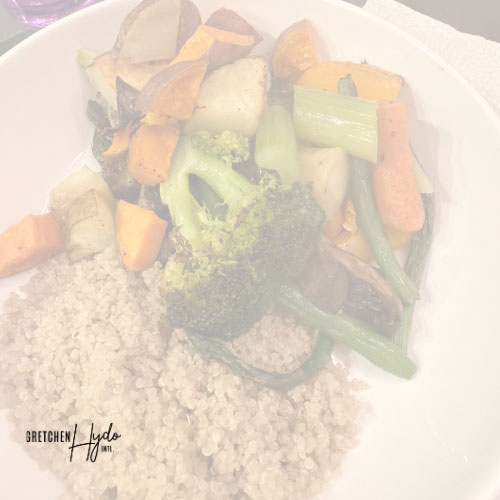
This fast does allow fruits, vegetables, beans, quinoa, lentils, and nuts (yeah me)but it isn’t designed to be indulgent. Scripture describes it simply:
“I ate no choice food; no meat or wine touched my lips…” Daniel 10:3
This fast is about simplifying and getting rid of the layers that keep you from hearing God because you are on autopilot and comfort yourself instead of feeling. It is meant to strip you down and take you to your edge, and that is the part I was the most interested in.
I did this fast with my son, which made the experience especially meaningful. We did it with intention. Each day we prayed together, for clarity, for spiritual awakening, for answers we were seeking, and to notice what it felt like to rely on God instead of our usual comforts. And, we checked in every night to say what we had learned.
What became clear very quickly was this:
Food is comfort. Not just nourishment, comfort.
I noticed how often I reached for food not because I was hungry, but because I wanted to feel safe or loved. I wanted hot tea with milk to feel comfort. I wanted chocolate to feel satisfied. I wanted bread to feel full. Food has a way of soothing us. And truthfully, I felt like something was missing without my usual diet. I am not a big eater, but I realized how enjoyable food is.
Here’s how the days unfolded, not just with food, but internally.
Day One
My head was busy. I noticed how quickly my mind jumped ahead, wondering how hard this would be, whether I’d stick with it, whether I was doing it “right.” Would I hear from God? What was the point. Why couldn’t Daniel have caffeine? I was eating, but mostly I was noticing my thoughts. And I noticed how many times I would overeat (yup with fruits and veggies – takes a lot by the way) so that I could feel satisfied. The satisfaction never came.
Day Two
I felt more spacious. Less focused on food and more aware of my inner state. I felt expectant, open. The mental noise wasn’t as loud, and I began to listen more closely, to myself and to God. I could see where I like to numb and check out. And something that really caught me off guard, were the dreams. They were wild. I did not sleep peacefully because I was dreaming of burning buildings and dogs being thrown off ships. I don’t even have a dog.
Day Three
This was a day of awareness. I began to see patterns clearly, how easily I reach for comfort, how quickly I want resolution instead of presence. Where I absorb other people’s feeling. I noticed my thoughts without trying to change them. I could really hear my inner criticism, worries, and ideas. I still didn’t sleep well.
Day Four
Answers came. Not all at once, but steadily. And I didn’t like some of them. I got to see myself for who I am when I am stripped down. I was less interested in reaching for anything outside myself and more willing to stay with what was unfolding. I took notes on what I was noticing and hearing. I slept a little bit better and I wasn’t obsessing about tea and milk. My attitude changed from this is hard to, I can do this.
Day Five
I realized I could keep going if I had to. I had originally committed to five days and I kept that commitment. I felt mixed with stopping but I knew that I had learned what I needed to and that going longer wasn’t necessary. I didn’t immediately reach for the tea, bread or cheese.
Here is the biggest lesson that I learned. You can be full and not satisfied. And that insight extended far beyond food.
It made me look at my life, at the ways we fill ourselves without noticing. With information, entertainment, noise, and constant input, often on autopilot. We fill our days and our minds and then wonder why clarity feels harder to reach or why we feel a little disconnected from ourselves.
When we’re full of the wrong things, there’s less room for what actually nourishes us.
During the fast, I also stepped away from Amazon, social media, and secular music. Not because those things are bad, but because I wanted to notice the small moments I check out. The subtle ways I cope. The times I reach for distraction instead of staying present and asking God for guidance. I wanted to see all of the places I get my dopamine hits from.
Here are some of the other things that happened:
I felt closer to God.
I could hear His voice more clearly.
I felt more connected to my son.
I felt proud of myself.
And yes, I truly enjoyed the chicken and mashed potatoes when I broke the fast.
But the deeper lesson was this:
I can sit with discomfort. I don’t need immediate satisfaction to be okay. And I can trust that the fast will end, my new dress is on its way (I love you online shopping).
That truth applies far beyond food. There are seasons in life and leadership where we are full, full of responsibility, effort, emotion, but not satisfied. And instead of immediately fixing, numbing, or distracting ourselves, sometimes the invitation is simply to stay present and listen.
The fast ends. The nourishment returns. And we’re stronger for having stayed.
This is a practice I plan to return to each year, a way to gently bring myself to the edge, to meet with God more clearly, and to uncover a new layer of awareness and truth. Not to deprive myself. But to remember what actually satisfies.
If this fast taught me anything, it’s this: We are far more capable of sitting with discomfort than we think and satisfaction does return. Sometimes the most powerful thing we can do is slow down long enough to listen.
Much Love,
Gretchen
